How Long Does It Take to Reduce Inflammation Through Diet?
Share
A common and clinically relevant question is how long does it take to reduce inflammation through diet. Human randomized controlled trials show that dietary changes can begin lowering inflammatory biomarkers within weeks, with more durable improvements occurring over several months depending on the type of inflammation and consistency of the intervention¹².
Inflammation is a necessary biologic response to injury, surgery, or illness. However, when inflammation becomes prolonged or poorly regulated, it can delay healing, impair recovery, and contribute to chronic disease. Diet plays a central role in determining whether inflammation resolves efficiently or persists¹.
Acute vs Chronic Inflammation and Why Timing Matters
The timeline for reducing inflammation through diet differs depending on whether inflammation is acute or chronic.
Acute inflammation occurs after surgery, injury, infection, or intense physical stress. In these settings, nutritional interventions can influence inflammatory signaling relatively quickly, particularly when digestion, immune demand, and muscle preservation are supported³.
Chronic inflammation develops over months or years and is often associated with metabolic dysfunction, aging, obesity, or autoimmune conditions. Reversing chronic inflammation through diet typically requires sustained intervention over several weeks to months¹².
Evidence From Human Clinical Trials How Quickly Diet Can Reduce Inflammation
Mediterranean Type Diets and Inflammation Reduction
Multiple randomized controlled trials and meta analyses demonstrate that Mediterranean style dietary patterns reduce inflammatory biomarkers in humans.
A systematic review and meta analysis of randomized controlled trials found that Mediterranean diets significantly reduced high sensitivity C reactive protein IL 6 and IL 17 compared with control diets¹. Most interventions ranged from several weeks to a few months, indicating that measurable inflammation reductions occur within this timeframe.
A separate twelve week randomized controlled trial reported significant reductions in IL 6 and hs CRP following adherence to a Mediterranean diet demonstrating that systemic inflammation can decline within approximately three months of dietary change³.
Large scale randomized trials also show that longer term Mediterranean diet adherence produces sustained improvements in inflammatory risk markers over time⁵.
Early Dietary Changes and Marker Shifts Within Weeks
Shorter dietary interventions also show measurable effects.
A controlled human dietary intervention demonstrated that a six week antioxidant rich dietary change significantly improved oxidative stress markers and inflammatory profiles in adults with cardiovascular disease⁴. This confirms that inflammatory biology can begin shifting within weeks of diet modification rather than requiring years.
Together these trials support the conclusion that diet driven inflammation reduction can begin rapidly when nutritional quality meaningfully improves.
Why Diet Influences Inflammation So Effectively
Diet affects inflammation through several interconnected mechanisms.
Food choices influence gut barrier integrity, immune signaling insulin sensitivity, oxidative stress and muscle protein turnover. Diets high in processed foods promote pro-inflammatory cytokines while nutrient dense diets supply the substrates required for tissue repair and immune regulation¹².
Importantly reducing inflammation is not achieved solely by removing inflammatory foods. It also requires supplying the body with the nutrients needed to rebuild tissue and resolve inflammatory signaling.
The Role of Amino Acids in Inflammation Resolution
Protein intake is often discussed in inflammation management but amino acids are the functional drivers.
Human physiology relies on specific amino acids to regulate immune function antioxidant defenses and muscle preservation during inflammatory stress.
- Essential amino acids help limit muscle breakdown during inflammation
- Leucine supports muscle protein synthesis and offsets inflammation driven catabolism
- Glutamine supports gut barrier integrity which strongly influences systemic inflammation
- Arginine and citrulline improve blood flow and tissue oxygenation supporting healing
Without sufficient amino acid availability even an otherwise anti-inflammatory diet may not fully support recovery.
Why Protein Quantity Alone Is Often Insufficient
Increasing protein intake alone does not guarantee delivery of the amino acids needed to regulate inflammation. Intact protein requires digestion and digestion may be impaired during surgery illness or metabolic stress.
In these contexts precision amino acid delivery can be more effective than simply increasing total protein grams. This distinction is particularly relevant in peri operative care and injury recovery and helps explain why clinical nutrition strategies increasingly emphasize amino acid composition rather than protein quantity alone³⁴.
Where Xcelerated Recovery® Fits In
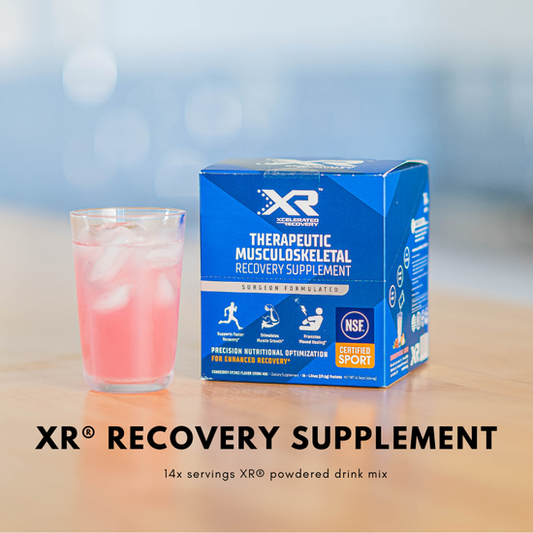
Xcelerated Recovery® was designed specifically to support recovery during periods of elevated inflammatory demand. Rather than functioning as a general protein supplement, XR delivers targeted amino acids in clinically relevant ratios to support muscle preservation, tissue repair and metabolic recovery.
By prioritizing amino acid availability rather than protein quantity alone XR aligns with the biologic mechanisms shown in human clinical trials to influence inflammation resolution and recovery efficiency¹³.
Individualizing an Anti Inflammatory Nutrition Strategy
The speed at which inflammation improves depends on whether nutrition is matched to individual needs. Body size, age , activity level, surgical stress and baseline muscle mass all influence amino acid and protein requirements.
To help quantify these needs Xcelerated Recovery® offers a Muscle Centric Calculator that estimates daily protein and amino acid targets and identifies gaps where precision supplementation may support recovery. This allows individuals and clinicians to move beyond generalized dietary advice toward a structured measurable approach.
Signs That Inflammation Is Improving
As dietary changes take effect common indicators of reduced inflammation include improved digestion, reduced bloating, decreased muscle soreness and joint stiffness, improved energy and sleep quality and faster recovery from physical stress or surgery. In clinical settings reductions in markers such as hs CRP may also be observed over time¹³.
So How Long Does It Take to Reduce Inflammation Through Diet
Based on human randomized controlled trials early improvements can occur within several weeks with more robust and sustained reductions typically observed over two to three months when dietary changes are maintained¹³⁴. Chronic inflammation may require longer term consistency but diet driven improvements are measurable well before a year.
Conclusion
Human randomized controlled trials demonstrate that inflammation can begin to decrease within weeks of dietary change with significant reductions commonly observed within three months¹³⁴. The most reliable results occur when diet quality is combined with adequate amino acid availability to support tissue repair and muscle preservation.
Xcelerated Recovery® was built around these principles emphasizing targeted amino acids to support recovery during periods of elevated inflammatory stress. For a personalized approach readers are encouraged to use the Muscle Centric Calculator to align dietary intake with physiologic recovery demands.
References
- Schwingshackl L et al. Impact of Mediterranean Diet on Inflammatory Markers: A Systematic Review and Meta Analysis of Randomized Controlled Trials. Nutrients. 2023;15(2):366.
- Estruch R et al. Primary Prevention of Cardiovascular Disease with a Mediterranean Diet. New England Journal of Medicine. 2013;368:1279–1290.
- Esposito K et al. Effect of Mediterranean Style Diet on Endothelial Dysfunction and Markers of Vascular Inflammation in the Metabolic Syndrome: A Randomized Trial. JAMA. 2004;292(12):1440–1446.
- Babio N et al. Short Term Effects of an Antioxidant Rich Diet on Inflammatory and Oxidative Stress Markers A Controlled Human Intervention. Nutrients. 2025;17(5):806.
-
Sureda A et al. Mediterranean Diet and Inflammatory Biomarkers A Randomized Controlled Trial. Nutrients. 2022;14(21):4577.
Amino acids and immune regulation
Specific amino acids regulate immune signaling, oxidative stress, and metabolic recovery during illness and injury.
Calder PC. Nutrients. 2020;12(4):1086.
Wu G. Adv Nutr. 2010;1(1):31–37.
Essential amino acids and muscle preservation
Essential amino acids stimulate muscle protein synthesis and reduce catabolism during inflammatory and immobilized states in humans.
Volpi E et al. Am J Clin Nutr. 2003;78(2):250–258.
Paddon-Jones D et al. J Clin Endocrinol Metab. 2004;89(9):4351–4358.
Leucine and inflammation-related muscle loss
Leucine acts as a key anabolic signal activating mTOR and helping overcome inflammation-associated anabolic resistance.
Phillips SM et al. Appl Physiol Nutr Metab. 2006;31(6):647–654.
Dardevet D et al. Nutr Res Rev. 2012;25(1):61–70.
Glutamine and gut barrier integrity
Glutamine supports intestinal barrier function, reducing systemic inflammatory burden in stressed and hospitalized patients.
van der Hulst RR et al. Lancet. 1993;341:1363–1365.
Wischmeyer PE. Curr Opin Gastroenterol. 2008;24(2):190–197.
Arginine, citrulline, and tissue perfusion
Arginine and citrulline increase nitric oxide bioavailability, improving endothelial function, blood flow, and wound healing.
Böger RH. J Nutr. 2007;137:1650S–1655S.
Schwedhelm E et al. Circulation. 2008;118(7):705–712.