Recovery Is a Metabolic Problem, Not Just a Mechanical One
Advances in orthopedic surgical recovery are increasingly converging with principles long established in sports performance science. The shared insight is simple, but often under-appreciated: recovery is fundamentally a metabolic challenge, not merely a mechanical or technical one.
Surgical technique matters. Rehabilitation matters. But without addressing the metabolic environment that governs muscle preservation, tissue repair, and anabolic signaling, recovery remains incomplete.

Surgery and Training Share the Same Metabolic Stress
Elite athletes do not train, or recover, while fasted. Their nutritional strategies are intentionally designed to support muscle protein synthesis, limit exercise-induced muscle damage, and restore performance capacity after physiologic stress.
Modern perioperative care is now reaching the same conclusion. Contemporary ERAS (Enhanced Recovery After Surgery) pathways increasingly acknowledge that patients should neither enter nor exit surgery in a prolonged catabolic state.
This alignment is not coincidental. Surgery and high-intensity training impose overlapping metabolic stressors, including:
- Acute muscle protein breakdown
- Inflammatory signaling
- Transient insulin resistance
- Negative nitrogen balance
When left unaddressed, this catabolic environment contributes to muscle atrophy, delayed functional recovery, impaired wound healing, and increased complication risk. In both athletes and surgical patients, the physiologic objective is the same: attenuate catabolism and restore anabolic signaling as early as possible.

Lessons From Sports Performance Science
Decades of sports nutrition research demonstrate that targeted carbohydrate and amino acid strategies meaningfully alter recovery trajectories. These interventions have been shown to:
- Reduce exercise-induced muscle damage (EIMD)
- Attenuate delayed-onset muscle soreness (DOMS)
- Accelerate return to training
- Improve substrate availability during periods of high metabolic demand
A comprehensive 2024 review published in Nutrients synthesizes this body of evidence, highlighting how nutrient timing, nutrient quality, and amino acid availability directly regulate anabolic signaling pathways while suppressing myofibrillar protein breakdown following metabolic stress.
A consistent finding across the literature is clear: remaining fasted after a physiologic stressor maintains a negative muscle protein balance, whereas targeted amino acid delivery shifts recovery toward a net anabolic state.

Translating Metabolic Recovery to Orthopedic Surgery
In the surgical setting, these same mechanisms have direct clinical relevance. Muscle preservation is not cosmetic, it is central to:
- Joint stability
- Functional mobility
- Metabolic health
- Rehabilitation efficiency
Strategies that blunt postoperative catabolism are associated with improved functional recovery, fewer wound complications, and lower infection risk.
While preoperative carbohydrate loading has become increasingly accepted within ERAS pathways, postoperative nutrition often remains an afterthought. Traditional recovery practices, such as juice and crackers, provide minimal anabolic stimulus and do little to address muscle protein balance during a critical recovery window.
Why Free-Form Amino Acids Matter
Free-form, targeted amino acids offer a physiologically efficient alternative. Unlike whole-food or protein-heavy approaches, they:
- Deliver essential substrates required for muscle protein synthesis
- Avoid excessive caloric load or gastric burden
- Minimize glycemic variability
- Directly stimulate anabolic signaling pathways
This makes them particularly suited for the immediate perioperative period, when patients are most vulnerable to catabolic loss and least tolerant of large meals.

A Shared Recovery Blueprint: Where XR® Fits
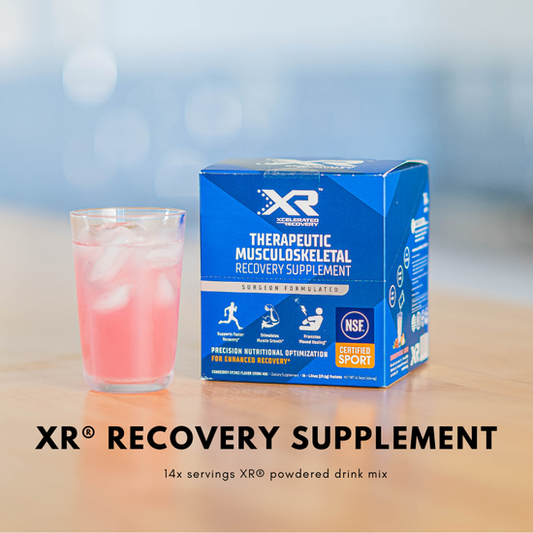
Xcelerated Recovery® was developed around this unifying framework: that the metabolic demands of elite athletic recovery and complex orthopedic surgery are more similar than different.
While the contexts differ, the biology does not.
XR® applies well-established principles from sports performance science, targeted amino acid delivery, metabolic readiness, and early anabolic support, to the surgical recovery environment, where muscle preservation and functional outcomes matter most.
The historical separation between performance nutrition and surgical recovery is narrowing. The evidence base continues to grow. The mechanisms are increasingly well defined. And the clinical implications are clear.
The performance and surgical worlds are no longer separate.
Recovery science is converging.
The blueprint is already written.
References
Bird SP, Nienhuis M, Biagioli B, et al. Supplementation Strategies for Strength and Power Athletes: Carbohydrate, Protein, and Amino Acid Ingestion. Nutrients. 2024;16(12):1886.