Understanding Incomplete Proteins: The Essential Amino Acid Gap
Share
Incomplete Proteins and the Essential Amino Acid Gap
Most people get enough protein. Fewer people get enough of the right amino acids at the right time. Here is the difference, and why it matters most when your body is under stress.
What Amino Acids Actually Do
Amino acids are the building blocks of protein, and protein is involved in nearly every biological process in the human body. Twenty amino acids combine in different sequences to build the structures that make you work: muscle fiber, connective tissue, enzymes, antibodies, hormones, and neurotransmitters.
They fall into three groups. Essential amino acids cannot be manufactured by the body and must come from the diet. Non essential amino acids are ones your body can build on its own. Conditionally essential amino acids are usually non essential but become essential during periods of physiological stress such as illness, trauma, burns, or surgery, when demand outpaces what your body can synthesize.
That third category is the one most people never hear about, and it is the reason a protein intake that works fine on an ordinary Tuesday can fall short two days after an operation.
Complete and Incomplete: A Useful Label With Limits
Proteins are commonly sorted into two buckets. Complete proteins contain all nine essential amino acids in proportions that meet human requirements. These come mostly from animal sources: meat, poultry, fish, eggs, and dairy. Incomplete proteins are low in one or more essential amino acids and are typical of plant foods such as grains, legumes, nuts, and seeds.
The label is useful, but it oversimplifies. Nearly every whole plant food contains all nine essential amino acids. What varies is the ratio. Each protein source has a limiting amino acid, the one present in the smallest amount relative to what your body needs. Grains tend to be limited in lysine. Legumes tend to be limited in methionine. Neither is missing anything outright.
This distinction matters because it changes the strategy. The goal is not to hunt for foods that contain some rare missing ingredient. The goal is to make sure the total daily supply of each essential amino acid clears the threshold your body needs to build tissue.
The Nine Essential Amino Acids
Histidine, isoleucine, leucine, lysine, methionine, phenylalanine, threonine, tryptophan, and valine. Each has a distinct role:
- Leucine is the primary trigger for muscle protein synthesis. It does not just supply raw material, it signals the machinery to start building.
- Lysine supports collagen formation and immune function.
- Methionine feeds methylation, metabolism, and detoxification pathways.
- Tryptophan is the precursor to serotonin, which influences mood and sleep.
- Isoleucine and valine work alongside leucine as branched chain amino acids in muscle metabolism and energy production.
Adequate intake of all nine matters for everyone, and it matters disproportionately for three groups: athletes under high training loads, older adults, and anyone recovering from illness, injury, or surgery.
Where Incomplete Proteins Show Up
Common sources include:
- Grains: rice, wheat, oats, barley, corn
- Legumes: beans, peas, lentils, chickpeas
- Nuts and seeds: almonds, walnuts, sunflower seeds, pumpkin seeds
- Vegetables: broccoli, spinach, and other greens contribute small amounts
None of these are poor foods. They are nutrient dense and deliver fiber, micronutrients, and phytonutrients that animal proteins do not. The point is not to avoid them. The point is to know what each one is short on so you can build the rest of the day around it.
What Happens When the Gap Stays Open
A diet built heavily on limited protein sources without attention to the total amino acid picture can leave you short. The consequences are rarely dramatic and rarely fast, which is exactly why they get missed:
- Reduced ability to build and maintain lean mass
- Weakened immune response
- Slower wound healing and tissue repair
- Fatigue, low mood, and reduced mental clarity, since several amino acids are neurotransmitter precursors
For people with dietary restrictions, and for anyone whose appetite has dropped, these effects compound quietly over weeks.
Combining Foods for a Complete Amino Acid Profile
Protein complementation means pairing sources whose limiting amino acids offset each other. The classic example is rice and beans. Rice is limited in lysine but rich in methionine. Beans are the reverse. Together the profile fills in.
Other reliable pairings:
- Whole grain bread with peanut butter
- Hummus with pita
- Lentil soup with a grain based side
- Oats with pumpkin seeds
One important correction to older advice: you do not need to eat complementary proteins in the same meal. Your body maintains a free amino acid pool and draws from what you have consumed across the day. Eating varied protein sources over the course of the day is sufficient. This gives you far more flexibility than the rigid meal by meal food combining rules that circulated for decades.
Plant Sources That Stand on Their Own
A handful of plant foods deliver all nine essential amino acids in adequate proportions with no pairing required:
- Soy in its various forms: tofu, tempeh, edamame, soy milk
- Quinoa, which also brings fiber, magnesium, and iron
- Buckwheat, useful in noodles and porridges
- Hemp seeds and chia seeds, easy to add to smoothies, oatmeal, or salads
- Spirulina, concentrated though usually eaten in small amounts
Building meals around these simplifies the math considerably for anyone eating a mostly plant based diet.
Four Myths Worth Retiring
"Plant based diets cannot supply enough protein." They can, with attention to variety and total intake. What plant diets do require is slightly higher total protein, since plant proteins are generally less digestible and lower in leucine per gram.
"Complementary proteins must be eaten together." Retired decades ago. The daily amino acid pool handles it.
"More protein is always better." More is not automatically better, but the specific fear here is misplaced. The claim that high protein intake strains healthy kidneys is not supported by the evidence. People with existing kidney disease should follow their physician's guidance. For healthy adults, higher intakes have not been shown to impair kidney function.
"Total grams are all that matter." This is the one that trips up the most people. Timing, leucine content per serving, and digestibility all affect whether the protein you eat actually gets used to build tissue. Forty grams of protein spread as trace amounts across the day does not stimulate muscle protein synthesis the way a single serving crossing the leucine threshold does.
When Food Alone Is Hard: Closing the Gap With Free Form EAAs
There are periods when whole food protein is the wrong tool for the job. After surgery, appetite drops, nausea is common, and the stomach tolerates volume poorly. That is precisely when amino acid demand climbs, because your body is rebuilding tissue and fighting inflammation at the same time. Older adults face a related problem called anabolic resistance, where more leucine is needed to trigger the same building response.
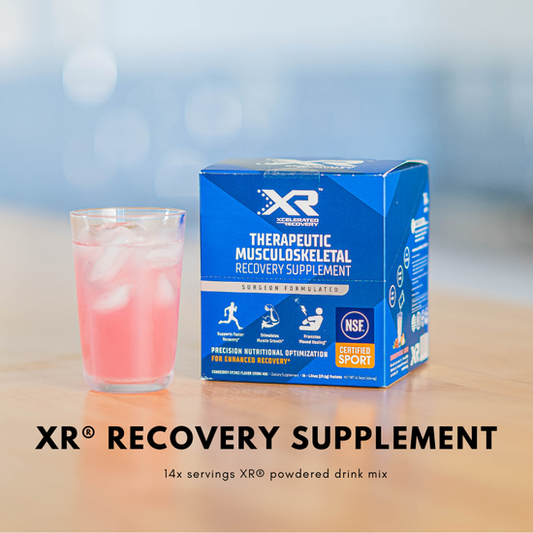
This is the gap Xcelerated Recovery was built to close.
XR is a free form essential amino acid formula, meaning the amino acids arrive already broken down. There is no digestion step and no protein to hydrolyze. They absorb rapidly, with minimal digestive burden and almost no caloric or volume load. Each serving delivers:
- Leucine, approximately 5 grams, well above the threshold associated with triggering muscle protein synthesis
- Glutamine, 5 grams, conditionally essential during surgical and metabolic stress
- Arginine, 4 grams, a substrate in nitric oxide production and collagen formation
- Creatine, 2.2 grams, supporting cellular energy availability during the recovery window
XR is NSF Certified for Sport, meaning every lot is tested against banned substances and verified for label accuracy, which matters for competitive athletes and for any clinician recommending it inside a care pathway. It is sucralose free and available in Mocha, Grape, and Unflavored.
We offer it in structured protocols built around procedure timelines: a three week program spanning the pre operative and post operative window for surgical patients, and a two week program for post procedure and orthobiologic recovery. Fourteen count boxes are available for anyone extending a regimen or supplementing outside a formal program.
To be clear about where this fits: XR is not a replacement for eating well. Whole foods carry fiber, micronutrients, and compounds no formula reproduces. XR is designed for the stretch of time when eating well is difficult and amino acid demand is at its highest.
Bringing It Together
Closing the essential amino acid gap comes down to three habits. Eat a variety of protein sources across the day rather than relying on one. Learn which amino acid your staples are short on so you can round out the rest. And recognize the periods when food alone will not carry the load, and support them deliberately.
Growth, repair, and immune function all run on the same supply chain. Keeping it stocked is one of the highest leverage things you can do for how well you recover and how well you perform.
Explore the XR essential amino acid formula and recovery programs at xrscience.org.
These statements have not been evaluated by the Food and Drug Administration. This product is not intended to diagnose, treat, cure, or prevent any disease. Consult your physician before beginning any supplement regimen, particularly around a scheduled procedure.